



info@lemeidentallab.com
+86 19928009909
Author: Lemei Date: Jan. 27, 2026
Is your dental lab constantly coming back to you, asking for more scan data on your All-on-X cases? Frustrating, isn't it?
In the digital era of All-on-X full-arch reconstruction, the biggest challenge for restorative dentists often isn't the technique itself, but the systematic and complete collection of data. Incomplete intraoral scans lead to endless back-and-forth with the lab, causing treatment delays and potentially compromising the long-term stability and function of the final restoration.
This article provides a clear, actionable checklist for your scans. Follow this logic, and you'll deliver data that allows your lab to fabricate a prosthesis with perfect passive fit every time.
Part 1: The Core Logic: Building a "Virtual Patient"
Modern All-on-X treatment has entered the era of the "Virtual Patient." The core idea is simple: using only the digital data you send, the lab can accurately recreate a 3D model of your patient's mouth, including occlusion and functional movements without ever seeing them.

Think of it like a puzzle. Every piece of scan data is crucial. Miss one, and the picture is incomplete. The restoration design then becomes an educated guess, not a precise calculation.
The sequence follows a "From Hard to Soft, From Static to Dynamic" principle. First, capture stable hard tissues (implants/abutments) and arch form. Then, record dynamic bite relationships.
Finally, add aesthetic and functional references. This ensures every step is built on an accurate foundation.
Part 2: The 5-Step Master Checklist
Use this list during your clinical workflow to ensure nothing is missed.
Step 1: Implant Position Data – The "Foundation"
This is the most critical data, determining whether the prosthesis will fit precisely.
What to Scan:
Implants/abutments with scan bodies: Ensure all scan bodies are fully seated. If a scan body isn't 100% seated(e.g., due to bone interference), the final prosthesis will not achieve correct passive fit.
Adjacent arch areas (gingiva, mucosa, remaining dentition): Provides the soft tissue boundaries.
The Logic: This accurately locates each implant's 3D position and axis. The scan body is the implant's digital "avatar." Scanning the surrounding tissue defines the biological boundaries for the prosthesis emergence profile.
Pro-Tip: Conquering the Edentulous Scan Challenge
To overcome stitching errors caused by featureless mucosa and long scan paths in edentulous cases, ensure supreme accuracy with tools like the TruAbutment IO Connect, iCam, etc, non-indexed splinting solutions.
How it works: Its pre-connected long-arm scan body adds multiple reference points, drastically reducing cumulative errors from stitching scans over smooth mucosa.
Scanning Tip: Scan the entire assembly along with the surrounding gingiva. The software recognizes it as a unified reference frame, significantly boosting accuracy for a reliably
passive-fitting framework.

Step 2: Arch Form & Bite Relationship – The "Frame"
This defines the "room" size and how the upper and lower "rooms" align.
What to Scan:
Complete maxillary and mandibular arch forms (from first molar to first molar).
Centric relation (CR) or maximum intercuspation (MI) bite record: Use PVS bite registration or digital bite recording.

Protrusive and lateral movement records (optional but recommended): Optimizes dynamic
occlusion design.
The Logic: Arch form dictates the prosthesis length, width, and curve. Accurate vertical dimension and centric relation are the bedrock of a stable, non-interfering occlusion.
Dynamic records allow the lab to perform functional tooth setup and occlusal adjustment proactively.
Step 3: Aesthetic & Functional Reference – The "Soul"
This transforms the prosthesis from "functional" to "personalized."
What to Scan/Capture:
Old denture, temporary prosthesis, or diagnostic wax-up: Scan both the tissue and occlusal surfaces.


Patient facial photos or 3D facial scan (front smile, side profile).
A high-quality, front-facing photo of the patient's smile (full face, looking straight at the camera—no downward shot or no upward shot).

The Logic: The old prosthesis holds valuable, patient-adapted information on vertical dimension, lip support, phonetics and
aesthetics. Facial data aligns the design with the patient's features (lip line, nasolabial angle, facial midline) for a Face-Driven Design.
Step 4: Supplemental Data for Complex Cases
Specific cases need extra data for success.
What to Scan:
The opposing arch: Mandatory if it has natural teeth or a fixed restoration.
Key anatomical structures (e.g., a large tongue, shallow buccal vestibule).
The Logic: The opposing arch's shape directly influences the prosthesis' occlusal design. Noting special anatomy alerts the
technician to design contours (polished surfaces, lingual space) for tongue comfort, food flow, and cleanliness.
Step 5: CBCT Data – The "Invisible Blueprint"
Not from an intraoral scan, but it's the foundational coordinate system.
What to Provide:
Post-op CBCT (DICOM format): Clearly shows implant-to-bone relationship.
Intraoral scan data (STL format).
The Logic: Fusing the STL and DICOM data lets the lab see the prosthesis design, implant positions and underlying bone/nerve structures in one 3D space. This is crucial for
ensuring biomechanically sound force distribution and ideal screw access leading to long-term success.
The Final Simple Checklist:
To ensure we can craft your perfect All-on-X prosthesis, please send us these 5 key elements:
1)Implant Position Data: Scan bodies on all implants/abutments with complete surrounding soft tissue.
2)Arch Form Data: Complete maxillary and mandibular arch scans.
3)Bite Record: A clear centric relation bite scan.
4)Reference Data: Tissue & occlusal scans of old dentures/temporaries.
5)Aesthetic Reference: High-quality front-facing smile and side-profile photos.
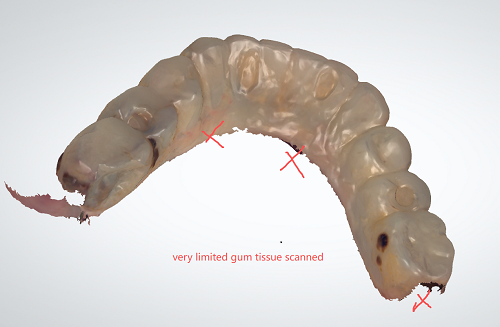
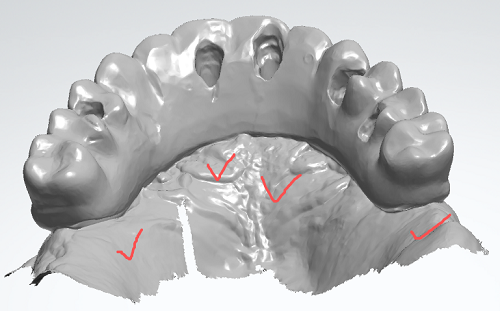
Regarding soft tissue scans: Please capture it completely.
The top image is an incorrect example. The bottom image is correct and what the lab expects to receive is a scan with full gingival contours.
This checklist marks your shift from being a mere "Data Sender" to the "Treatment Director." When you submit a complete data package with these 5 dimensions, you're not just assigning a task—you're delivering a complete "Virtual Patient."
This professionalism and rigor are the true foundation for reducing chairside time, achieving superior outcomes, and building lasting trust with a top-tier dental lab.
This precise data is the cornerstone of success. When you provide this complete package, our digital expert team can accurately reconstruct your "Virtual Patient" and focus on designing and crafting a restoration that excels in aesthetics, function, and long-term stability.
We look forward to receiving your next All-on-X case and partnering with you to achieve perfect full-arch reconstruction for your patients.
Contact: Betty Cao
Phone: +86 19928009909
E-mail: info@lemeidentallab.com
Whatsapp:008619928009909
Add: Floor 4, Bldg A, No. 6 Eurasia Road, Torch Development Zone, Zhongshan City, Guangdong Province, China 528437